
Towns · September 22, 2025 · By June Takeda-Ross
A weekend in Kingston
If you're thinking about moving here, don't just tour houses. Spend a weekend. Here's how I'd spend mine, if I were seeing Kingston for the first time.
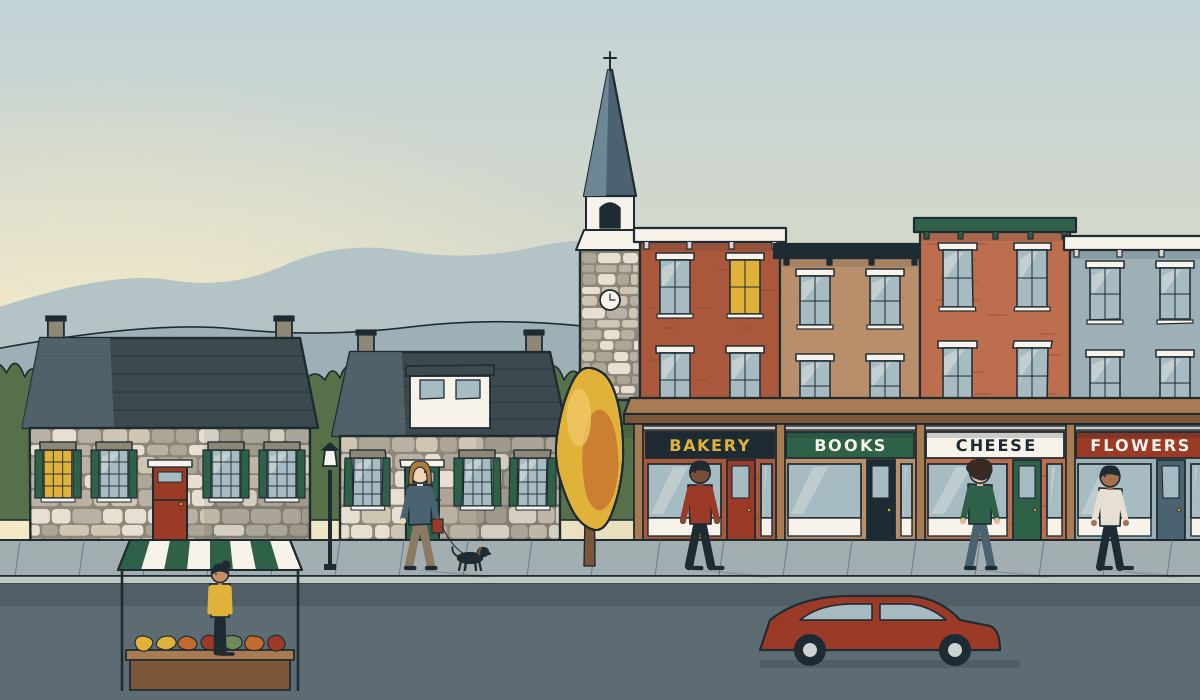
I grew up fifteen minutes north of Kingston, and I've been selling houses here for seven years. I still find new things. People who come up for a single Saturday of showings often leave thinking Kingston is one place. It's really three, plus a ring of neighborhoods and hamlets around them, and they feel different from one another. The best way to understand which one fits you is to walk all three.
Wear good shoes. Bring a jacket after September; the wind comes off the river.
Saturday morning: Uptown and the Stockade
Start Uptown, in the Stockade District, the oldest part of the city. Kingston was New York's first state capital, in 1777, and that October the British burned it. Many of the stone houses on these blocks were rebuilt inside their scorched walls, and you can still see them on the corners where four 18th-century stone houses face each other across the intersection. Walk the old stockade line, look at the Senate House, and stop in at the old Dutch church, whose congregation goes back to 1659.
On summer and fall Saturdays there's a farmers market Uptown. Get there early: by ten it's a crowd, and the good bread is gone. The covered sidewalk along the shops on the main commercial street is a Kingston landmark of its own and a good place to watch the town wake up.
What the houses are like: stone and brick in the center, very few on the market at any time, and they need owners who enjoy old-house projects. On the streets just outside the Stockade you'll find Victorians and early 20th-century frame houses with porches, on small lots. Walking distance to everything Uptown, but street parking only on many blocks.
Saturday afternoon: Midtown
Walk or drive south along Broadway into Midtown, the old commercial and industrial middle of the city. Midtown is where Kingston's arts scene has grown up over the past decade: studios and makers in old factory buildings, a performing arts center, murals on the brick walls, and new apartment and condo buildings on lots that were empty not long ago. It's also where you'll see the most change in progress, and some blocks are still rough around the edges.
What the houses are like: the most variety and often the best value in the city: two- and three-family houses, small single-family houses on narrow lots, and newer condos. Midtown is where I sell the most to first-time buyers. The Foundry Lofts on Spark Street, where I've sold several units, is one of the new buildings here.
Saturday evening: the Rondout
Head downhill to the Rondout, Kingston's 19th-century waterfront on Rondout Creek, where canal boats from Pennsylvania once unloaded coal and steamboats left for New York. The brick commercial buildings along the waterfront are now restaurants, shops and apartments. Walk the boardwalk along the creek, look at the boats at the maritime museum, and watch the light change on the water. If you have time before dark, walk out toward the river to see the lighthouse at the mouth of the creek.
What the houses are like: steep streets of Victorians and two-families climbing up from the water, with some river and creek views from the higher ones. Several are rentals or owner-occupied two-families. Some low-lying streets near the water are in flood zones; check the maps and ask for an insurance quote.
Sunday morning: the trails
Kingston is well connected by rail trails, built on old railroad lines. The trail out to Kingston Point runs along the river to a small beach and park, a good flat walk or ride with coffee. If you prefer the woods, the trails heading west of the city link up with longer routes toward the Catskills, and the Ashokan Reservoir's trail is a short drive. Long-distance cyclists know Kingston as a stop on the statewide trail network that runs up the valley.
The Catskills begin a short drive west. Many people who buy in Kingston do so precisely because they can be at a trailhead in the mountains in thirty minutes and at the Thruway in five.
Sunday afternoon: the outskirts
Before you head home, drive the edges of the city and the neighboring towns: Hurley's stone houses and farm fields, Port Ewen across the creek, the Town of Ulster to the north, Saugerties further up. This is where you'll find mid-century ranches and capes on half-acre lots, the kind of house I list often. My listing at 156 Esopus Ridge Road is one: a 1958 ranch with a big yard, at $529,000.
And if you've got an hour, go to an open house or two. We hold them most Sundays; check our open houses page for this weekend's.
The honest notes
- Getting to the city: there's no Metro-North in Kingston. Commuter buses to Manhattan take about two hours. Amtrak runs from Rhinecliff, 15 to 20 minutes' drive across the bridge. If you commute daily, think carefully; if you go in once or twice a week, most people find it manageable.
- Prices: Kingston's median sale price was $449,000 this year, the lowest of the six towns we track, with homes taking about 27 days to go under contract. That's still well up from five years ago, and many locals feel priced out. We think that's worth saying plainly.
- Taxes: they vary a lot between the city and the surrounding towns. Ask for the tax bill on any house you're serious about.
- Winter: it's quieter, but it's not closed. Kingston is a year-round city, not a weekend town.
If you'd like to talk about which part of Kingston might suit you, I'm at our office at 48 Stockade Row, right in the Stockade District, most days. Stop by after your walk. (845) 555-0142.