
First-time buyers
Your first house, without the fog
Nobody is born knowing what a mortgage commitment is. June Takeda-Ross taught middle school for eleven years before she joined us, and she still explains things the same way: once, clearly, and again if you ask.
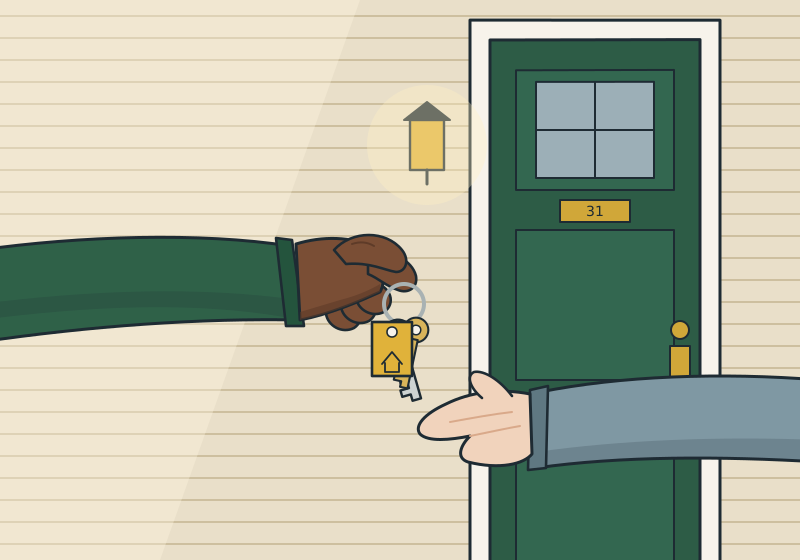
Start with the monthly number, not the price
Most first-time buyers start by asking what they can afford to buy. The better question is what you can comfortably pay every month, including the parts nobody puts on the listing card. In the Hudson Valley the monthly cost of a house is principal and interest, plus property taxes (often $600 to $1,200 a month on a modest house here), homeowner's insurance, mortgage insurance if you put down less than 20%, any condo or HOA fee, and the utilities. Oil heat in an old house in February is a real number. So is a well pump.
A lender will tell you the most you can borrow. That's a ceiling, not a target. We'd rather you buy a house you can keep paying for in a year when the furnace dies and the car needs tires. Use our mortgage calculator with an actual tax figure from a listing you like, and see how it feels.
The loans first-time buyers use
You don't need 20% down. Plenty of people who buy their first house here put down far less. Here are the common types, described generally. A lender will tell you which you qualify for; we don't arrange loans and we don't get paid by lenders.
- Conventional, low down payment
- As little as 3% down for first-time buyers who qualify. Private mortgage insurance is added to the monthly payment until you reach about 20% equity, then it can come off.
- FHA
- A federally insured loan with 3.5% down and more forgiving credit requirements. Mortgage insurance usually stays for the life of the loan unless you refinance. Some older houses need repairs before an FHA appraisal will pass.
- VA
- For eligible veterans and service members: often no down payment and no monthly mortgage insurance.
- USDA rural
- A federal program for designated rural areas, with no down payment for buyers under certain income limits. Parts of Ulster and Columbia counties qualify; the village centers usually don't.
- State and county programs
- New York's state housing finance agency offers first-time buyer mortgages with competitive rates and down payment assistance, through participating lenders. Some counties and cities have their own grant programs, usually with income limits and a homebuyer class. Money runs out each year, so ask early.
Down payment assistance often comes as a forgivable second loan: you don't repay it as long as you live in the house for a set number of years. Read that part. If you sell or refinance early, some or all of it comes due.
How it goes, for a first-timer
- Get your paperwork together
Two years of tax returns, recent pay stubs, two months of bank statements, and an explanation for anything odd (a gift from a parent, a job change, a gap). Lenders love boring files.
- Get pre-approved
Talk to two or three lenders and compare their loan estimates line by line, not just the rate. You don't need one to tour, but we require a pre-approval letter before we submit an offer, the same as for every buyer.
- Sign a buyer agreement with us
A short written agreement, required everywhere since August 2024 before an agent can show you a house. It states what we're paid, says that's negotiable, and that we can't be paid more than that. Often the seller covers it. If not, we'll talk about how to handle it in your offer, so there are no surprises at closing. If you'd like to try us out first, you can sign a one-day touring agreement instead.
- Look, and keep a list
Most first-time buyers see 10 to 20 houses. Write down what bothered you after each one. Patterns appear.
- Make an offer
We'll look at recent sales with you and write it up. In New York the offer is short; the real terms go into the contract your attorney negotiates.
- Hire an attorney and an inspector
Do this right away. The attorney reviews the contract and handles the closing; the inspector tells you what you're actually buying. We'll give you several names for each.
- Sign the contract and pay the deposit
Usually 10%, though with a low down payment loan it's often less. It's held in escrow by the seller's attorney and goes toward your down payment.
- Mortgage commitment, then closing
The appraisal, underwriting and title work take four to eight weeks. Don't buy a car or open new credit cards in the meantime; lenders check again right before closing.
Cash you'll need at closing
Your down payment is only part of it. For a $400,000 house with 5% down, a first-time buyer here might bring something like this. These are illustrations, not quotes.
| Item | Example |
|---|---|
| Down payment (5%) | $20,000 |
| Attorney | $1,750 |
| Inspection, radon and water test | $900 |
| Title insurance and search | $2,800 |
| Mortgage recording tax (on a $380,000 loan, about 1%) | $3,800 |
| Lender fees and appraisal | $2,500 |
| Prepaid taxes, insurance and escrow | $4,500 |
| Roughly | $36,250 |
Two things work in your favor. First, sellers can agree to a credit toward your closing costs, within your lender's limits, and in a balanced market they often do. Second, the "mansion tax" (1% on homes of $1 million and up) won't apply to most first homes, and the 0.4% state transfer tax is the seller's to pay.
Buying an old house as your first house
Many of the affordable houses in the valley are old: 1920s frame houses in Kingston, 1940s cottages in Saugerties, 1950s ranches on the edge of town. They are often good houses. They also come with a predictable list of things to check.
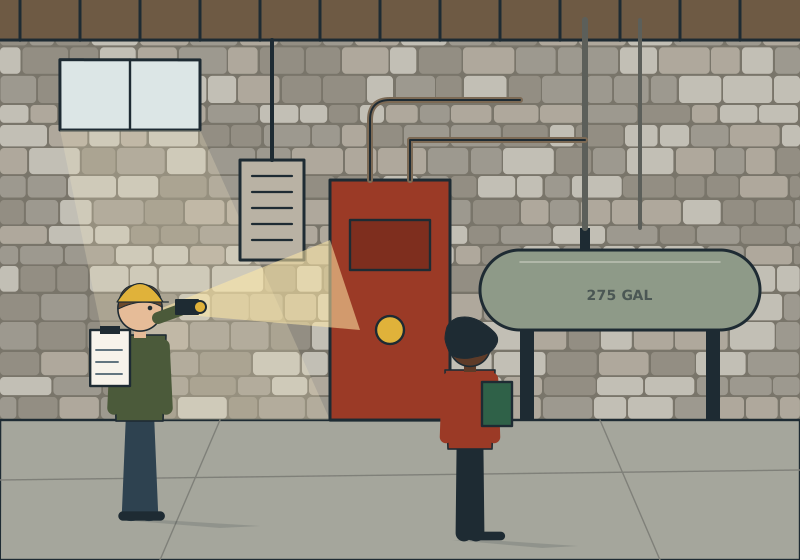
- Heat. Oil, propane or gas? How old is the boiler or furnace? Is there a buried oil tank from an earlier system?
- Electric. 100-amp service is common and may need an upgrade. Knob-and-tube wiring can make insurance hard to get.
- Water and septic. Outside the village and city centers, many houses have a well and a septic system. Test both.
- Foundation. Fieldstone and block foundations often take on water in spring. A damp basement isn't a dealbreaker; a wet one needs a plan.
- Lead paint. Any house built before 1978 comes with a lead disclosure. Take it seriously if there will be young children in the house.
- The disclosure form. Since March 2024 New York sellers can no longer skip the Property Condition Disclosure Statement with a $500 credit. Read it before you sign the contract, and ask about every "unknown".
Look at 303 Wren Hollow Road in Saugerties, $375,000, for an honest example: a 1940 cottage with a working wood stove, a 1962 bathroom and a price that reflects both. Or 156 Esopus Ridge Road in Kingston, a 1958 ranch on half an acre for $529,000.
A condo instead?
Kingston has a small but growing supply of new-construction condos, and for some first-time buyers they make more sense than a house: no roof to replace, no driveway to plow. You pay a monthly HOA fee instead, which covers the building's exterior, insurance on common areas and a reserve fund. Ask for the budget and the reserve study, and find out whether a special assessment is planned. Unit 4B at The Foundry Lofts is a two-bedroom, two-bath loft built in 2023, listed at $415,000 with an HOA of $412 a month.
First-time questions
Who counts as a first-time buyer?
For most programs, anyone who hasn't owned a home in the last three years. Divorced buyers who only owned with a former spouse sometimes qualify too. Check each program's own definition.
What credit score do I need?
It depends on the loan. FHA loans go lower than conventional ones, but every point helps your rate. A lender can tell you what would move your score before you apply.
Can my parents help with the down payment?
Usually, yes, with a signed gift letter and a paper trail showing where the money came from. Tell your lender early.
Do I have to pay you?
Your buyer agreement states the amount, and it's negotiable. In many sales the seller covers it. Either way, you'll know before we tour, not after.
Should I rent here first?
If you're new to the valley, it isn't a bad idea. Our rental desk in Kingston has a few units at a time; see rentals.
Coffee with June
June runs our free first-time buyer evenings at the Kingston office, 48 Stockade Row, every spring and fall, on Tuesdays at 6:30. Bring your questions and your worst-case budget. Or call her at (845) 555-0190.